
In a recent decision set to spark debate within the fashion industry, the European Union Intellectual Property Office (EUIPO) has rejected Thom Browne, Inc.’s application for position mark 018980277.
The EUIPO deemed the submitted sign to lack the necessary distinctive character under Article 7(1)(b) of the European Union Trade Mark Regulation (EUTMR).
The Heart of the Dispute: What Does “Distinctive Character” Mean?
In accordance with European trademark law, a sign must possess the distinctive capacity to allow the relevant public to identify the commercial origin of the goods or services it refers to in order to be registered.
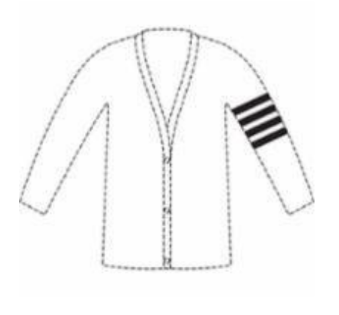
The critical issue in this case lies in the nature of a position mark: a sign that doesn’t manifest as a word or a figurative element, but rather relies on the specific manner in which certain graphic elements are placed or applied to a defined part of the product.
The mark requested by Thom Browne, Inc. consists of four parallel horizontal bands of equal width, applied to the left sleeve of a garment with sleeves. According to the EUIPO, however, this combination of elements does not substantially differ from other common decorations in the fashion sector and does not convey any “brand message” to the average consumer.
Thom Browne’s Stance
Thom Browne, Inc. submitted its observations on December 3, 2024, arguing that the sign in question possesses sufficient distinctive capacity to fulfill the function of a trademark, even if only a minimal level of distinctiveness is recognized. Furthermore, the company contested the Office’s approach, accusing it of failing to conduct a comprehensive investigation into consumer perception of the mark and of not considering the widespread commercial use of the sign.
Thom Browne, Inc. finally highlighted that a simple online search with terms like “four bars shirts” returns hundreds of results related to its products.
In light of this, the company requested a new evaluation that considers the actual use of the mark and all relevant data, deeming the Office’s conclusion unjustified in the absence of a complete examination.
The EUIPO’s Perspective
Despite the arguments presented, the Office decided to uphold the rejection, stating that:
- The four parallel stripes positioned on a sleeve represent a graphic element commonly employed in the clothing and fashion industry. EU case law confirms that simple geometric shapes like lines, circles, rectangles, and pentagons are not, in themselves, suitable for performing a distinctive function (13/04/2011, T-159/10, Parallelogramme, EU:T:2011:176, §§ 28, 30; 12/09/2007, T-304/05, Pentagon, EU:T:2007:271, § 33; 13/07/2011, T-499/09, Purple, EU:T:2011:367, §§ 25, 28). According to the Office, the applicant has not provided convincing arguments or concrete evidence to support the distinctiveness of the requested mark, nor has it invoked Article 7(3) of the EUTMR by presenting documentation attesting to the acquisition of distinctiveness through use. In the absence of such elements, it cannot be held that the relevant public perceives the sign as a trademark or identifies it as an indication of the product’s commercial origin.
- The Office rejects the criticism that its assessment is based on mere assumptions, stating that it conducted a concrete analysis in accordance with established case law. According to this case law, signs composed of simple geometric shapes applied to clothing items are not, in themselves, suitable for indicating the commercial origin of the product. The Office further emphasizes that it is not obliged to provide specific examples to support public perception, as this is an assessment based on common experience in the sector. In the absence of convincing evidence or arguments from the applicant, the requested sign lacks inherent distinctive character. This conclusion is consistent with previous decisions of the Office and the Boards of Appeal in similar cases concerning position marks in the clothing sector, where registration was granted only after the demonstration of acquired distinctiveness through use. In this case too, the Office concludes that the sign does not possess distinctive character under Article 7(1)(b) EUTMR.
- The applicant criticized the Office for not considering the actual use of the mark, which is easily verifiable online. The Office responded that it is aware of the widespread use of similar signs in the fashion industry and does not deny the use of the sign, but clarified that use, alone, does not demonstrate distinctiveness or public perception as an indication of origin. Furthermore, the applicant has not provided evidence that the mark has acquired distinctiveness through use. The Office finally reiterated that it is not required to demonstrate third-party use to justify the lack of distinctiveness. The EUIPO also highlighted that the requested mark does not sufficiently differ from other graphic elements used by various manufacturers in fashion. In particular, it stressed that similar signs have been rejected in the past unless the company demonstrated an acquisition of distinctiveness through use – something Thom Browne, Inc. has not done satisfactorily.
Conclusion
The EUIPO’s decision confirms the jurisprudential orientation that decorative signs and simple shapes cannot be registered as trademarks unless a distinctive perception by the public is demonstrated. In the case of the “four stripes,” the absence of adequate evidence prevented its legal distinctiveness from being recognized.
The case highlights the importance for companies to solidly document the use of a sign to obtain protection as a position mark, overcoming its merely decorative nature.
We will see if Thom Browne, Inc. decides to appeal, having the right to do so under Articles 67 and 68 EUTMR.
Antonella Letteriello